By Yingling Garage Doors and Openers ·
If you’ve spent enough time working on garage doors in Penn Hills, Pennsylvania, you begin to notice something: many of the garages here weren’t designed around the garage doors and automatic openers we use today.
Penn Hills has a large number of older homes and garages that were built during a very different era of garage door technology. Over the decades, heavy wooden doors have been replaced by sectional steel doors, automatic openers have become standard, and modern track and spring systems have changed considerably.
But the garages themselves haven’t gotten any taller.
That’s one reason we encounter so many low-headroom garage doors, extension-spring systems, unusually tight clearances, and custom installations in Penn Hills.
At Yingling Garage Doors and Openers, working on these older garages has taught us that replacing a garage door in Penn Hills isn’t always as simple as measuring the opening and ordering a standard door.
Sometimes the most important part of the job is figuring out how to make modern garage door equipment work properly in a space that was never designed for it.
Penn Hills Homes Were Built in a Different Era
Much of Penn Hills developed long before today’s garage door systems became standard. Drive through some of the older neighborhoods and you’ll still find garages that tell the story.
Some originally had heavy wood doors. Others used older one-piece doors or early sectional doors. Many garages were built with relatively low ceilings and very little space between the top of the garage door opening and the structure above it.
Automatic garage door openers weren’t necessarily part of the original design either.
A modern garage door needs room for tracks, rollers, springs and other hardware. An automatic opener requires additional clearance and a suitable mounting location.
In newer construction, those things can be considered when the garage is designed. In an older Penn Hills garage, we’re often working with whatever space was left for us decades ago.
Why Are Low-Headroom Garage Doors So Common in Penn Hills?
On a standard garage door installation, the horizontal tracks curve upward from the vertical tracks and extend back into the garage. That system needs a certain amount of room above the door.
Many Penn Hills garages simply don’t have much of it.
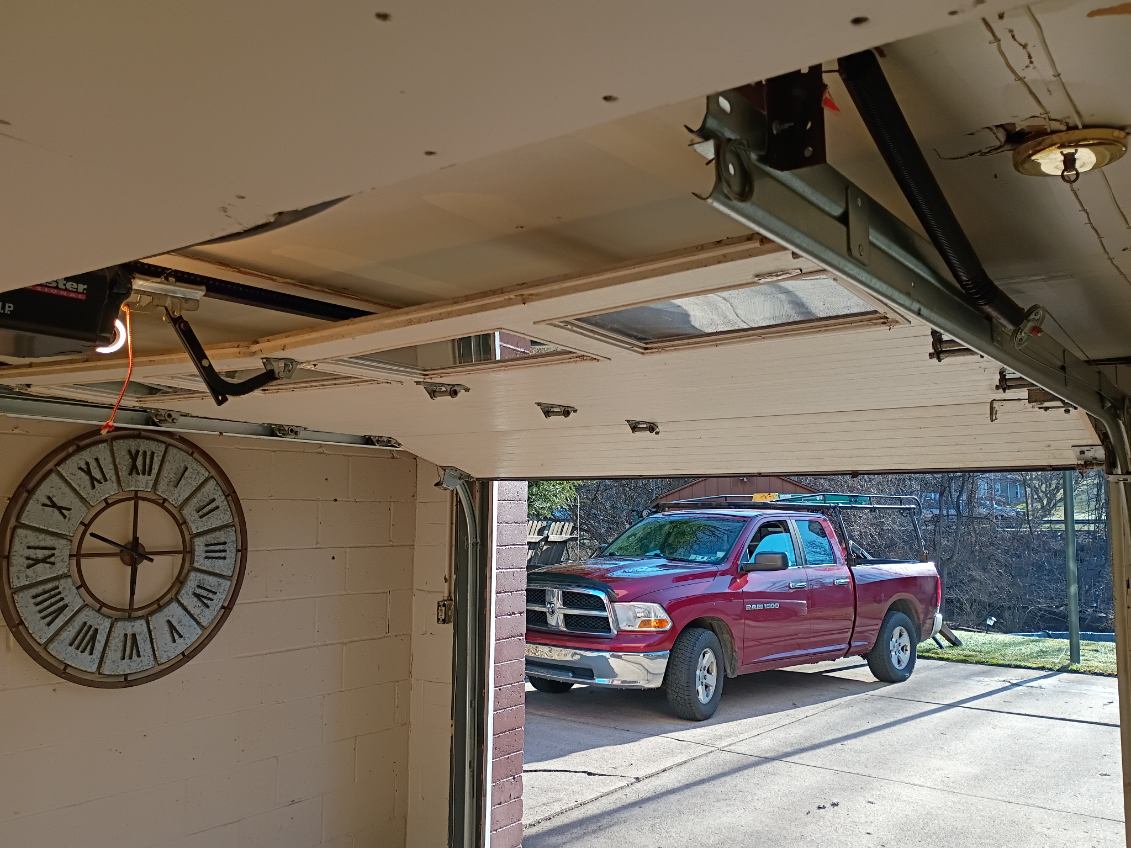
We’ve worked on garages where every inch matters. Older framing, low ceilings, beams, pipes and other structural conditions can leave very little room for a conventional track configuration.
That’s where low-headroom garage door hardware becomes important. Low-headroom systems are designed to allow a sectional garage door to operate when there isn’t enough clearance for a typical installation.
In Penn Hills, these aren’t necessarily unusual specialty situations. They’re something we encounter regularly.
Extension Springs Are Still Everywhere
Another thing you’ll see frequently in older Penn Hills garages is the extension-spring garage door system.
Extension springs normally run alongside the horizontal tracks and stretch as the garage door closes. When properly installed and maintained, they help counterbalance the weight of the door.
Modern torsion-spring systems are extremely common today, but that doesn’t mean every older garage should automatically be converted to one. The available headroom, framing, door size and existing configuration all have to be considered.
There are Penn Hills garages where the original design and extremely limited space make a low-headroom extension-spring arrangement a practical solution.
The goal shouldn’t be to force every garage into the same modern configuration. The goal should be to determine which system works safely and correctly for that particular garage.
The Challenge of Replacing an Old Garage Door With a Modern Sectional Door
This is where experience with older garages really starts to matter. Imagine a garage that was built around an old wood door decades ago. Now the homeowner wants a modern insulated steel sectional door.
The opening may still be perfectly usable, but the new door and hardware don’t necessarily operate the same way as the original system.
You have to look at available headroom, ceiling height, track clearance, spring location, existing framing, opener clearance, pipes or beams, the actual opening size, and how much usable garage-door opening can be preserved.
Sometimes a standard installation works. Sometimes it doesn’t. And that’s where custom problem-solving becomes part of the job.
Six-Foot-Six Garage Doors and Other Older Sizes
One characteristic we’ve encountered repeatedly around Penn Hills is the 6-foot-6-inch-high garage door.
Today, many homeowners are accustomed to seeing 7-foot doors as a common residential size. But older garages don’t always follow today’s expectations.
A garage with a 6′6″ opening may have very little room above it to begin with. Simply trying to turn it into a conventional modern installation can create additional problems.
That’s why the existing structure needs to be evaluated before deciding what hardware and track configuration should be used. A few inches may not sound like much. On a low-headroom garage door installation, a few inches can determine whether the entire system works.
Some Penn Hills Garages Were Never Designed for an Automatic Opener
Today we tend to think of an automatic garage door openeras part of the garage. That wasn’t always the case.
Many older garages were constructed when manually operated garage doors were normal. When openers were added years later, installers sometimes had to get creative.
We still encounter the results today. You may see unusual mounting positions, altered framing, extremely tight clearances or older opener installations that simply wouldn’t be considered ideal by today’s standards.
When replacing one of those openers, the answer isn’t always to put the new machine exactly where the old one was. We look at the entire door system first.
Sometimes improving the track or door setup can create a better opener installation. Other times the existing garage construction dictates where everything has to go.
Old Wood Doors Tell Part of the Story
Some longtime Penn Hills homeowners may remember the old heavy wood garage doors that were once common throughout the area. A few older examples are still out there.
We’ve even encountered older configurations involving one-piece wood doors and spring systems mounted into or around the surrounding structure.
Those doors belonged to a different generation of garage door technology. As homeowners replaced them over the years, newer sectional doors often had to be adapted to the existing garages.
The garage may have been built for one type of door, modified for another and later modified again when an automatic opener was installed. By the time we’re called decades later, we may be looking at several generations of garage door technology in the same garage.
Why We Don’t Believe in a One-Size-Fits-All Installation
A garage door can weigh hundreds of pounds and moves through the same path thousands of times during its life. Clearances matter. Track geometry matters. Spring balance matters. The way the hardware interacts with the building matters.
That’s why we don’t believe the answer to every older Penn Hills garage is simply, “This is the standard way we install them.”
Sometimes standard is exactly right. Other times the garage requires a low-headroom setup, different track configuration, careful opener placement or another solution appropriate to the structure.
Can an Older Penn Hills Garage Be Upgraded?
In many cases, absolutely.
Limited headroom doesn’t automatically mean you can’t have a modern garage door. An unusual opening doesn’t necessarily mean the garage can’t be upgraded. And an older garage that wasn’t originally designed for an automatic opener doesn’t necessarily mean you can’t have one today.
It means the garage needs to be looked at carefully.
We’ve spent years working around the unusual framing, low ceilings, extension springs, older doors and tight spaces found throughout Penn Hillsand Pittsburgh’s eastern suburbs.
Sometimes the solution is straightforward. Sometimes it takes some thinking. Those difficult installations are often the ones we enjoy the most.
Local Experience Makes a Difference
There’s something to be said for recognizing what you’re looking at when you walk into an older Penn Hills garage.
If you’ve worked on enough of them, certain things become familiar. You start recognizing why the previous installer positioned the tracks a certain way. You understand why extension springs were used instead of a standard torsion setup. You know why an opener is squeezed into an unusual location.
Most importantly, you learn not to assume that something can’t be done simply because a standard installation won’t fit.
Penn Hills has its own collection of older homes and garage configurations, and we’ve been working on them for years. That’s experience you don’t get from an installation manual.